
By the itavi Team
Learning games can help children stay engaged during travel by giving them something to notice, create or work out. Simple guessing games, compact puzzles and age-appropriate educational toys offer opportunities to explore while families are on the move.
The best choice depends on the child and the journey. An activity that works during a quiet afternoon at the hotel may feel different on a crowded flight. A few familiar options, with room to adapt, can make travel easier for everyone.
What makes a good learning game for travel?
Parents often look for activities that will keep children occupied throughout a journey. But a game’s value also lies in what children can do with it: make choices, test an idea, ask questions or share something they have noticed.
A guessing game invites a child to think about clues. A puzzle gives them a problem to work through. Drawing offers a way to express something they have seen.
Good travel activities are easy to carry, manageable in the space available and suited to the child’s interests and abilities. They should also be easy to pause. Travel comes with interruptions, and children need time to rest as well as play.
Which learning games work well during travel?
You do not need a large collection of supplies. A small selection of activities can offer different ways to play as the journey unfolds.
Observation games
Invite children to look for something specific: a red vehicle, a circular sign or an object beginning with a particular letter.
For younger children, choose a familiar color or shape. Older children can take turns creating clues for everyone else.
Guessing games
Choose an animal, object or place and let the child ask questions to work out the answer.
Preschoolers may enjoy a few direct clues: “It has four legs and barks.” Older children can try yes-or-no questions and gradually narrow the possibilities.
Shared storytelling
Begin with a character and a setting, then take turns adding to the story. Something from the trip can provide the starting point: a boat, a mountain or a building that caught the child’s attention.
Let the story follow their ideas. The conversation is part of the activity.
Compact puzzles
A small puzzle or travel logic game can give children something to work through independently or alongside an adult.
Choose a level that offers an achievable challenge. Too many loose pieces can make a puzzle frustrating in a confined space, so consider how it will work before packing it.
Drawing and creative play
A notebook, reusable drawing board or water-reveal pad gives children a simple way to create.
Try an invitation such as “Draw something you want to see when we arrive,” then let them decide what comes next.

How do you choose educational toys for travel?
Educational toys are most useful when they suit both the child and the setting. Look for materials that invite children to build, arrange, imagine or experiment.
The supplied travel guides include options such as water-reveal coloring pads, reusable drawing tools, fabric activity books and bendable wax sticks. Compact construction sets may also work well when there is a stable surface and enough space.
Before packing, consider:
- Can the child use it comfortably in their seat?
- Are there pieces that could easily disappear?
- Does it offer more than one way to play?
- Is it appropriate for the child’s age and abilities?
- Will it be easy to put away when plans change?
Check the manufacturer’s age guidance, particularly for toys with small parts or magnets. For toddlers, choose larger materials intended for their age group and plan for adult supervision.
A familiar toy can be as useful as a new one. In an unfamiliar setting, children may welcome something they already know how to enjoy.
Simple preschool activities for the journey
Preschool activities can begin with conversation and observation. Many require little more than an adult’s attention.
Find something that matches
Choose a color or shape and look for examples together. Once the child understands the game, let them choose what everyone should find next.
Remember what you saw
After looking at a picture or a few objects, ask the child what they remember. Keep the number of items small and add more if they enjoy the challenge.
Finish the story
Start with a simple sentence: “When we arrived at the hotel, we found a tiny door.”
Ask what was behind it. Follow the child’s answer with another question or take turns continuing the story.
Draw and describe
Invite the child to draw something from the journey, then ask them to tell you about it.
Their explanation may reveal details that are not obvious in the drawing. Give them room to describe it in their own words.
Copy a quiet rhythm
Tap or clap a short pattern for the child to repeat. Then switch roles.
On a flight or in a shared space, use gentle finger taps so the game remains comfortable for others.

Math games for kids on road trips and flights
Math games for kids can draw on things already happening around them: numbers on signs, groups of objects or the time remaining before arrival.
Choose a challenge that fits the child’s understanding. Early learning might begin with counting a few objects, while older children may enjoy comparing quantities or estimating time.
Number spotting
Pick a number and look for it on road signs, gate displays or other visible information.
For children who recognize several digits, try finding them in order. Passengers can lead the game while the driver stays focused on the road.
More, fewer or the same?
Draw two small groups of shapes in a notebook. Ask which group has more or whether they are equal.
Invite the child to change the drawing so both groups have the same number.
Guess my number
Choose a number within a range the child understands. Let them guess, using “higher” and “lower” as clues.
Begin with a small range and expand it when they are ready.
Travel-time challenges
For older children, use the journey as a starting point: “It is 2 p.m., and we expect to arrive at 3:30. How much time is left?”
Talk through the answer together. The aim is to explore the problem, with time to revise an answer.
Can reading apps be part of early learning during travel?
Books, audiobooks and age-appropriate reading apps can offer another way to spend time during a long journey.
The original resource list includes Epic, Skybrary, Khan Academy Kids, Duolingo ABC, PBS Kids Games and Vooks. Before traveling, check the current age guidance, subscription terms and download options for any service you plan to use. Test downloaded content without an internet connection before departure.
An app labeled “educational” still deserves a closer look. Consider whether the content is understandable, whether it invites meaningful participation and whether the child can use it without becoming frustrated.
When possible, share part of the experience. Ask about a character, discuss a choice or connect the story to something your child already knows.
The American Academy of Pediatrics emphasizes the importance of content, adult involvement and making room for other activities when considering children’s media use.

Hands on activities for kids
How do you balance screens and hands-on activities?
A long journey may include a story, a drawing activity, a game and some quiet time. What works can change as children become tired, hungry or ready for something different.
Look at the experience as a whole. Is there room for conversation, rest and movement when possible? Is the child enjoying the activity or continuing because it is difficult to stop?
For younger children, hands-on exploration and interaction with caregivers are important parts of learning. A screen can be one option within the journey, alongside opportunities to talk, notice and play together.
Parents do not need to fill every moment. Looking out of the window or taking a break can be part of traveling, too.
Can travel activities reflect a holiday or destination?
Familiar materials can take on a new theme without adding much to the packing list.
For Easter travel, children might draw an egg with repeating patterns, create a spring animal from age-appropriate craft materials or invent a story about a rabbit visiting a new city.
The destination can also provide ideas. Invite children to draw a building they noticed, imagine a story about a local animal or compare the shapes in a landmark.
These activities give children a way to respond to the place they are visiting through their own observations and ideas.
How itavi continues the experience at your destination
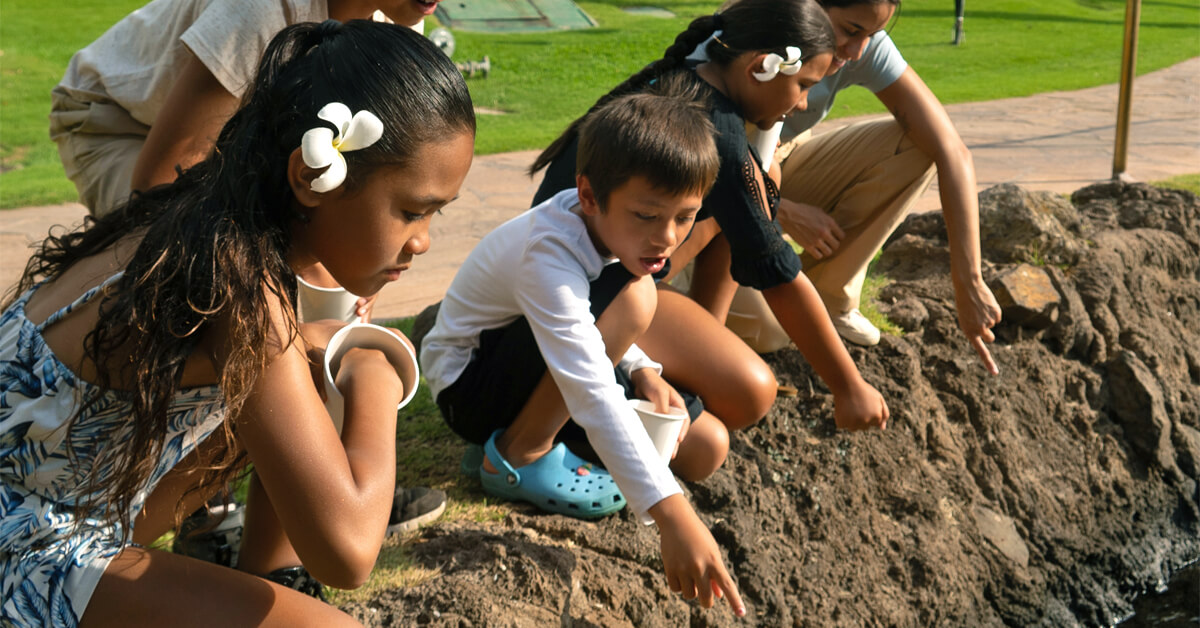
At itavi, learning is part of a childcare experience that brings together play, exercise and arts and crafts, with connections to the local culture of the destination.
That approach gives children different ways to participate during their stay. They can explore a story, create something of their own or enjoy an activity that introduces them to the place their family is visiting.
For parents, thoughtful childcare makes room to enjoy dinner, attend an event or take time to themselves. For children, it offers an experience designed with their interests in mind.
Planning a hotel stay or group event? Contact itavi to discuss thoughtful childcare for your family or guests.
Sources
- lajollamom.com
- www.amazon.com
- tollbit.madeformums.com
- www.trendhunter.com
- www.toydirectory.com
- www.raindropchess.com
- apps.apple.com
- www.beginlearning.com
- publications.aap.org
- link.springer.com
- pmc.ncbi.nlm.nih.gov
- treehouseschoolhouse.com
- awards.creativechild.com
- wanderlyadventures.com
- www.nationalgeographic.com
- www.mathschool.com
- www.abcmouse.com
- apps.apple.com
- www.skybrary.org
- mwm.ai
- blog.khanacademy.org
- www.aap.org
- pmc.ncbi.nlm.nih.gov
- ccf.ny.gov